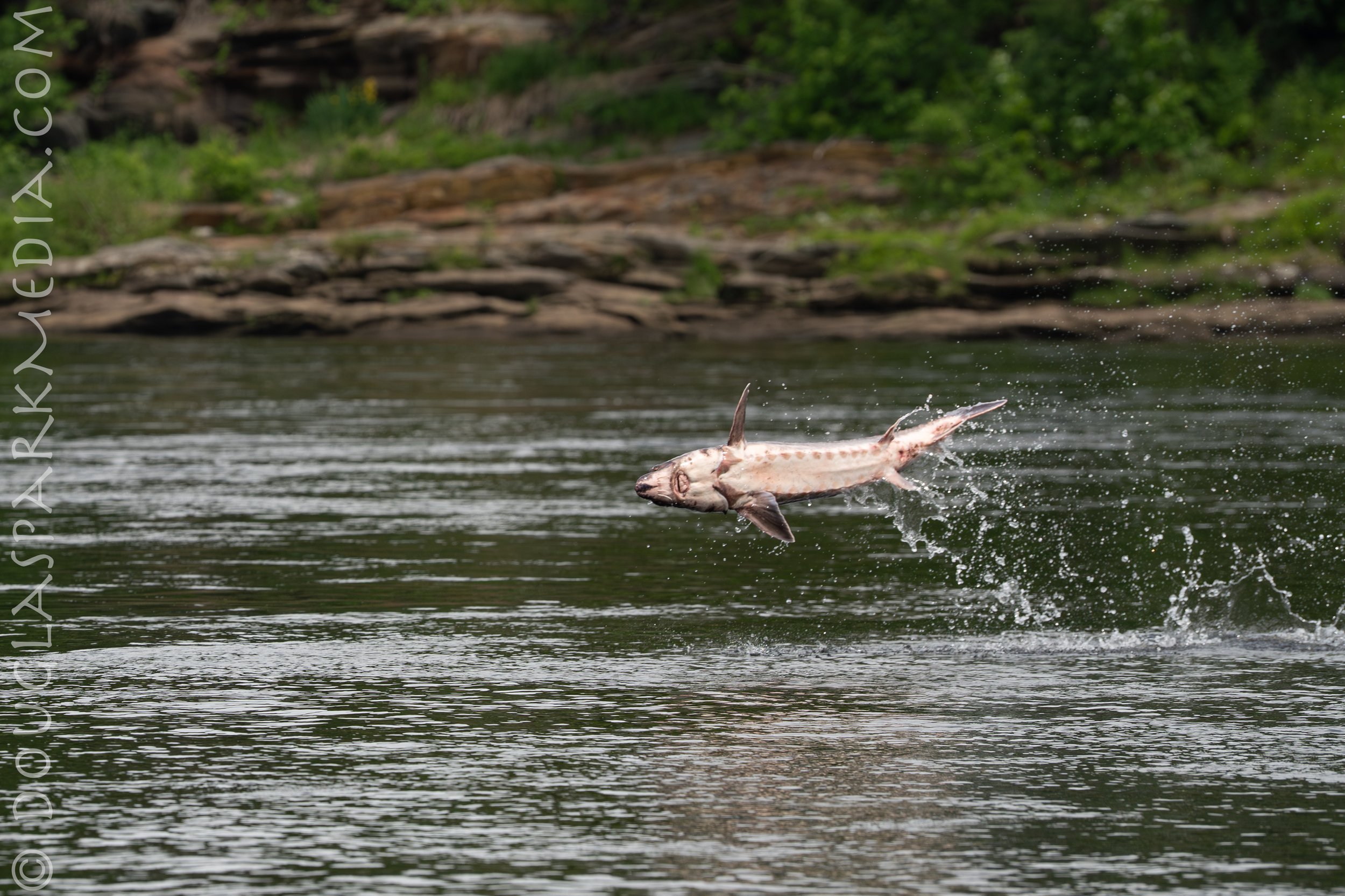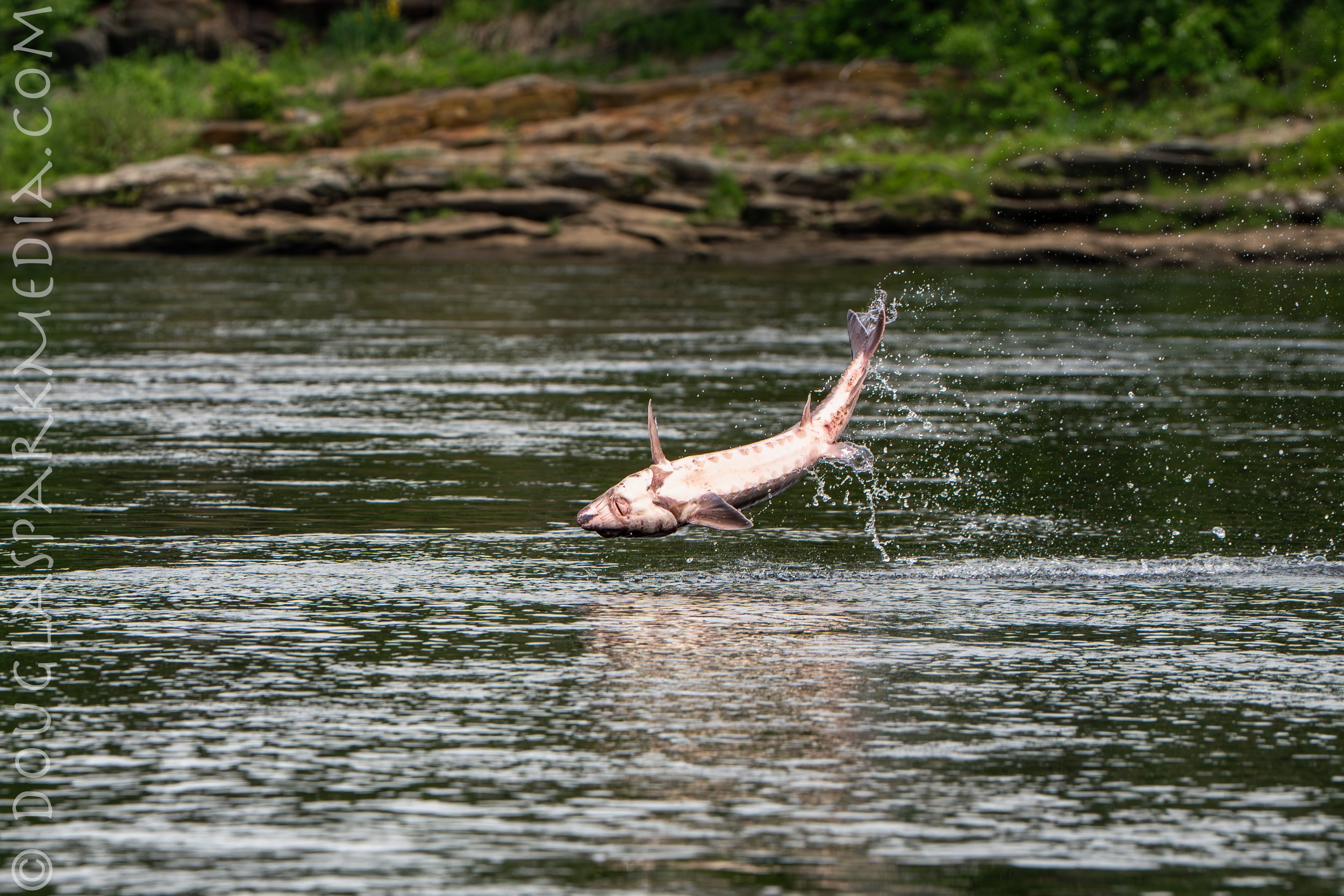
Photographing an airborne sturgeon is a challenge so some chalk my photos, particularly the focus, up to an accident, or worse photoshop. The truly ill informed call it AI.
The photos traveled great online distances in June when I first posted them. A local news outlet shared them and they travelled even further. Hundreds of thousand of views and hundreds of comments and shares.
One of the photos is on the move again this month in an ad campaign by Down East Magazine for their annual photo contest.
On the whole, the comments are gratifying: complimentary, sometimes even awestruck. It’s easy to ignore the dumb ones: one complained about my writing style when I had quoted the John Burroughs Award winning words of Franklin Burroughs in his seminal work Confluence: Merrymeeting Bay.
But the comments labeling them an accident are like a splinter under my fingernail.
In no particular order—except that failure is part of any worthwhile new thing—here are the steps I took to plan this accident:
I failed
I read about sturgeon behavior
I observed the sturgeon without trying to photograph them
I stopped trying to capture every leap
I reread
I observed some more
I let the idea percolate for a year and a half
I came back and failed again
I compromised my photographic ideals about straight photography and practices
I put aside some photographic rules
I adapted things I learned from other wildlife photography and photographers
I compromised my goals
I was patient with the fish and with myself
I spend a lot of time on the Androscoggin River’s edge where it runs between Brunswick and Topsham, Maine.
I spend a lot of time with a camera in my hand; a quarter of a century has passed since I first considered photography a discipline, to be practiced.
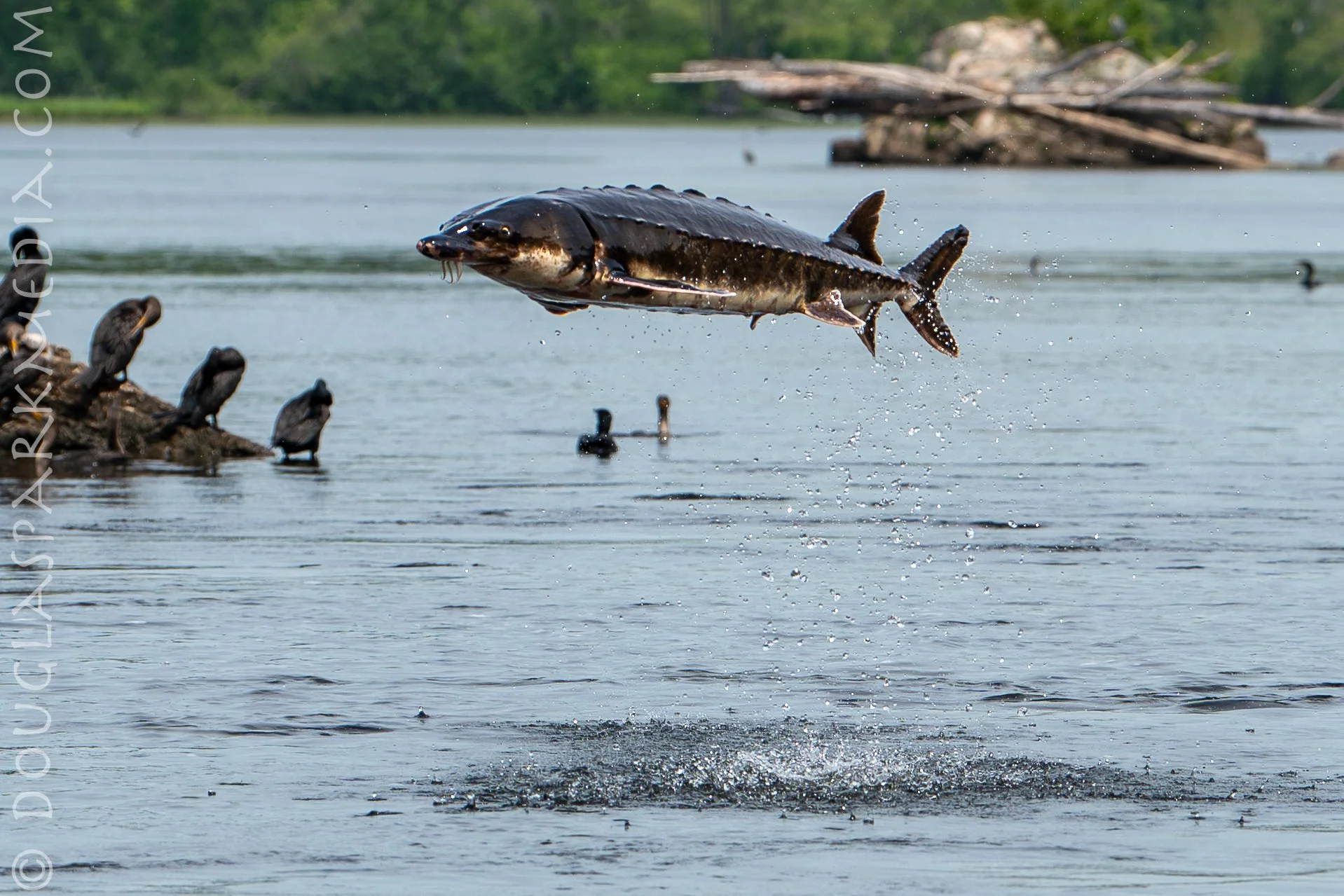
On this day, after compromising my goals, I made a half-dozen really solid sequences of sturgeon breaking the surface of the water, barrel rolling through the air trailed by droplets of river water sown in their wake, and then slamming back down into their native element, a monumental fount the only sign that their six foot long 200 pound bodies had been aloft.
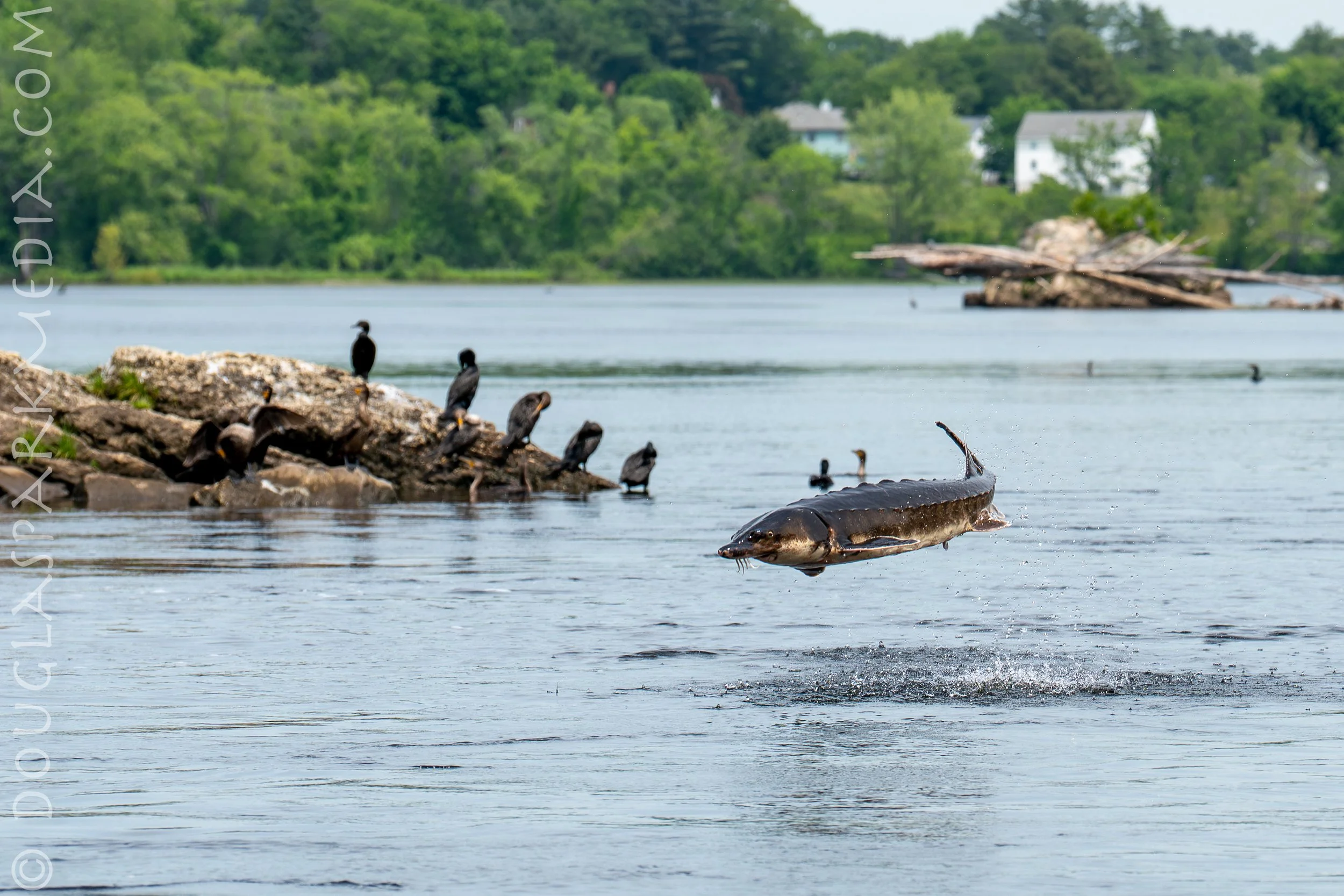
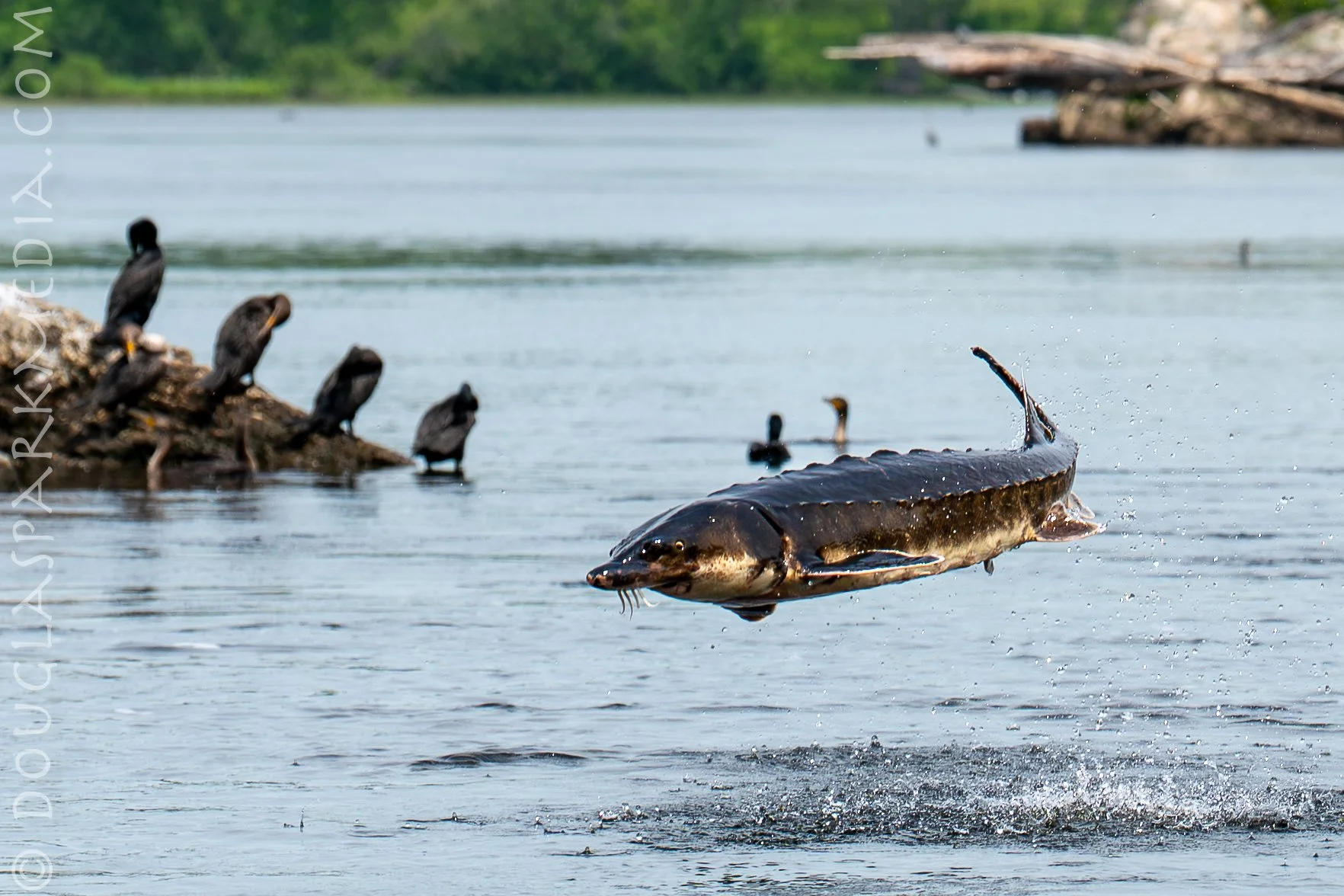
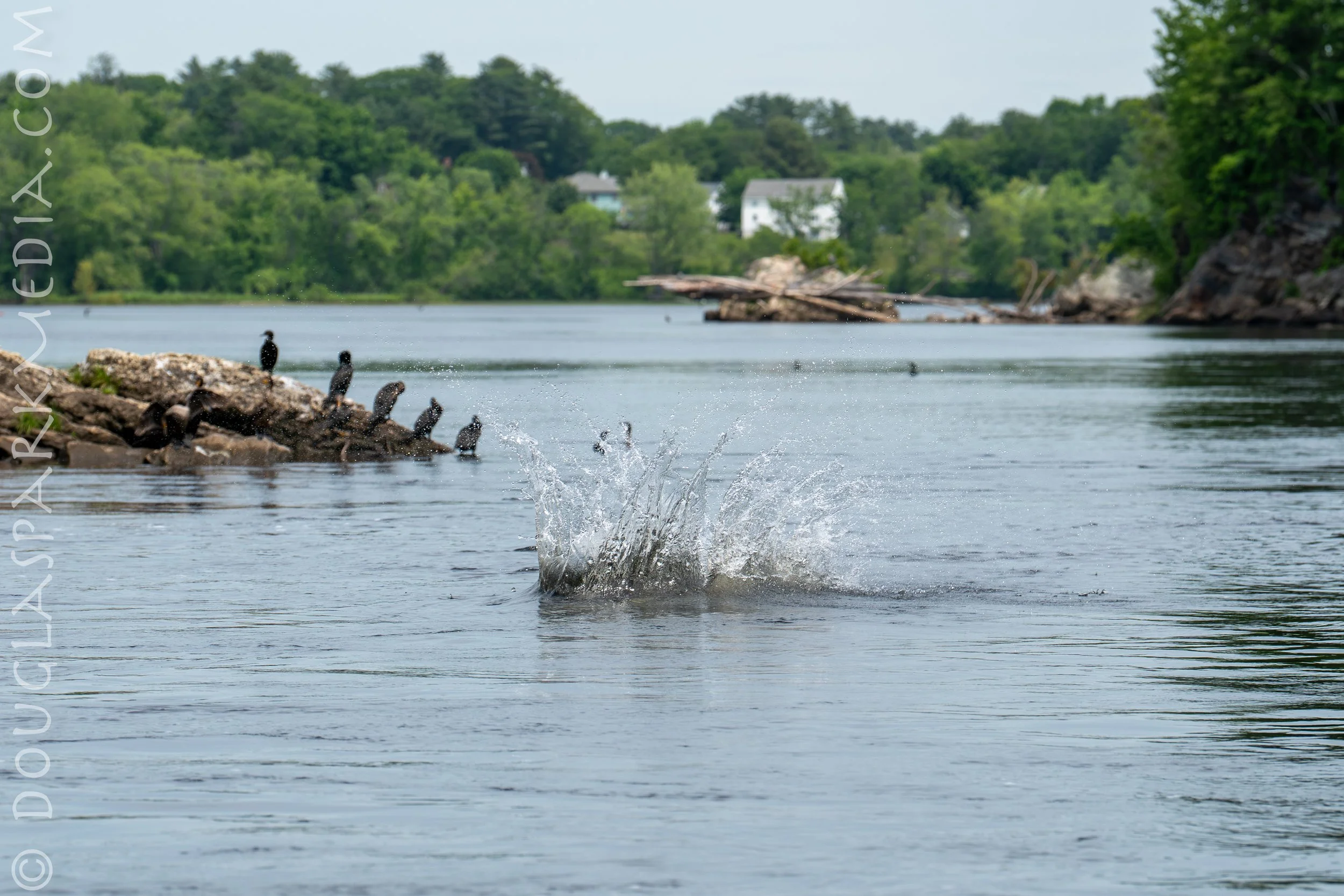
It is the sound of the impact that draws many observers’ attention. Sturgeon leap so suddenly and move fast enough that the spume of their re-entry is often the only thing that confirms the fish had even been there in the first place.
But I captured sequences, some just two frames, others as many as six frames. Sixty-four frames yielded eighteen sharp images, along with another three that I kept even though the focus was off; they help me illustrate my miscues while demonstrating an interesting facet of the fish’s behavior. Of the eighteen three make excellent sharing material while another handful are decent too as they illuminate the fish’s body parts and behaviors.
One I submitted to the Down East Magazine Photo contest: it wasn’t my favorite but it rated higher with my kids. Assuming their judgement is marginally less biased than mine I went with their choice.
The camera is a Nikon Z6iii with a 70-200mm f/2.8 Nikon lens.
Getting my eye off the view finder.
I am a traditionalist. I keep my eye on the view finder when composing and shooting. I learned with a Nikon FM . The only thing approaching an auto setting on that thing was its light meter. I never use the screen on the back of the camera to compose an image.
But I learned that I needed to free my peripheral vision from the camera. This did not mean adapting to using the new fangled thing on the back of the camera. I needed to have complete freedom to shoot with both eyes still on the fish, not on the camera.
I held the camera at about the height of my sternum and pivoted my torso at my hips to follow the fish so that my eyes and the barrel of the lens remained in line. I sat down with my feet planted as if I was sitting on a chair, at the water’s edge.
Standing is less stable and opens up the temptation to move around and chase every splash.
Foregoing the zoom.
I learned that somewhere around 135 mm on my 70-200 was the sweet spot. Enough reach that could be amplified by cropping (gasp!). The day before I learned at 200 mm it was difficult to keep the fish jumping closest to me in the frame. I also learned that trying to adjust the focal length while shooting this apparition was likely to cause the autofocus to find something in the background or foreground, as in the sequence below; the added another layer of movement brought in some uncertainty. The strongest photo is the third for its sharp focus. It illustrates nicely the dorso-ventrally compressed body, the elengated snout and the fish’s downward facing mouth.
The last frame? Crisp, but it’s the splash. The phantasm that makes you say, “what was that?”
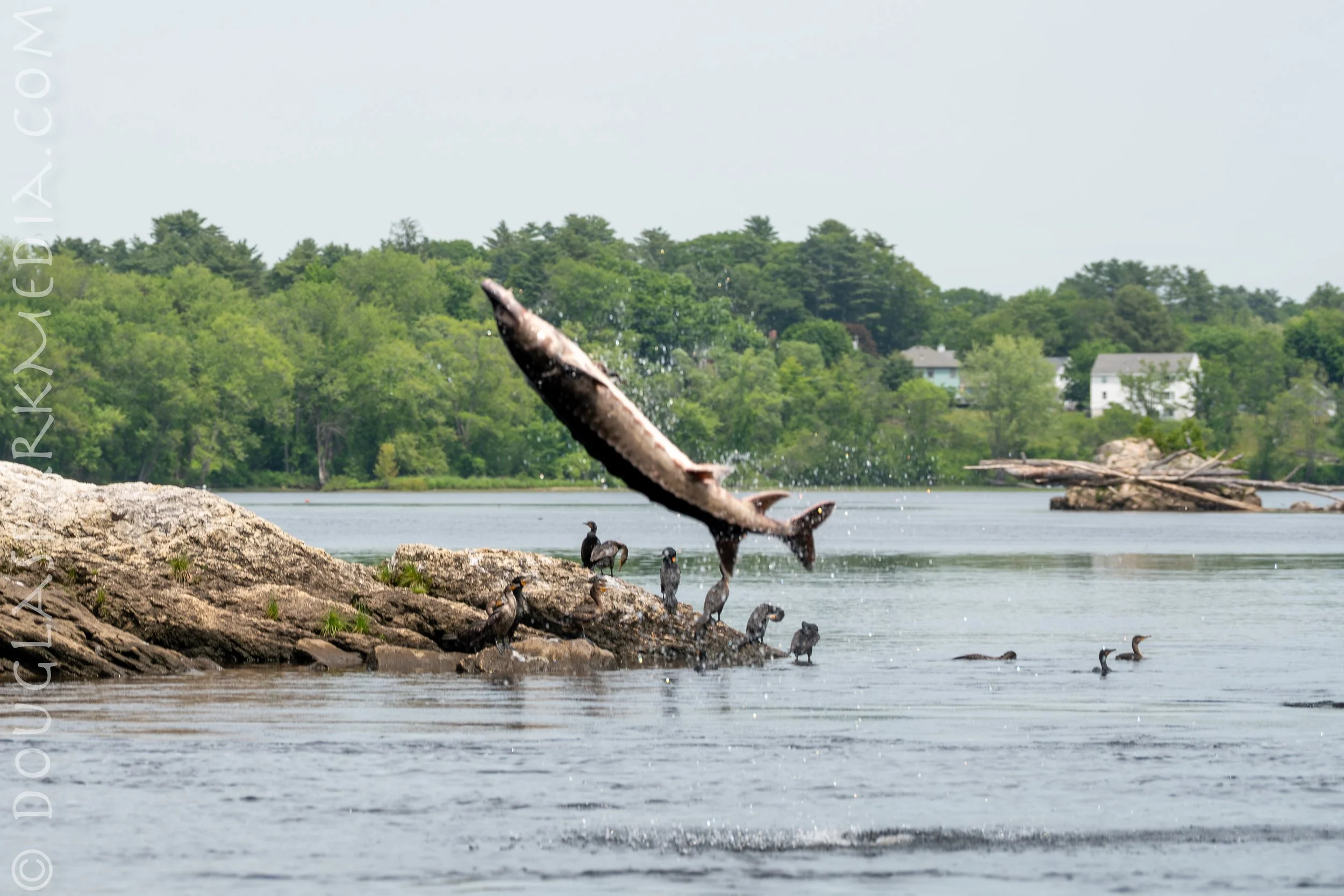
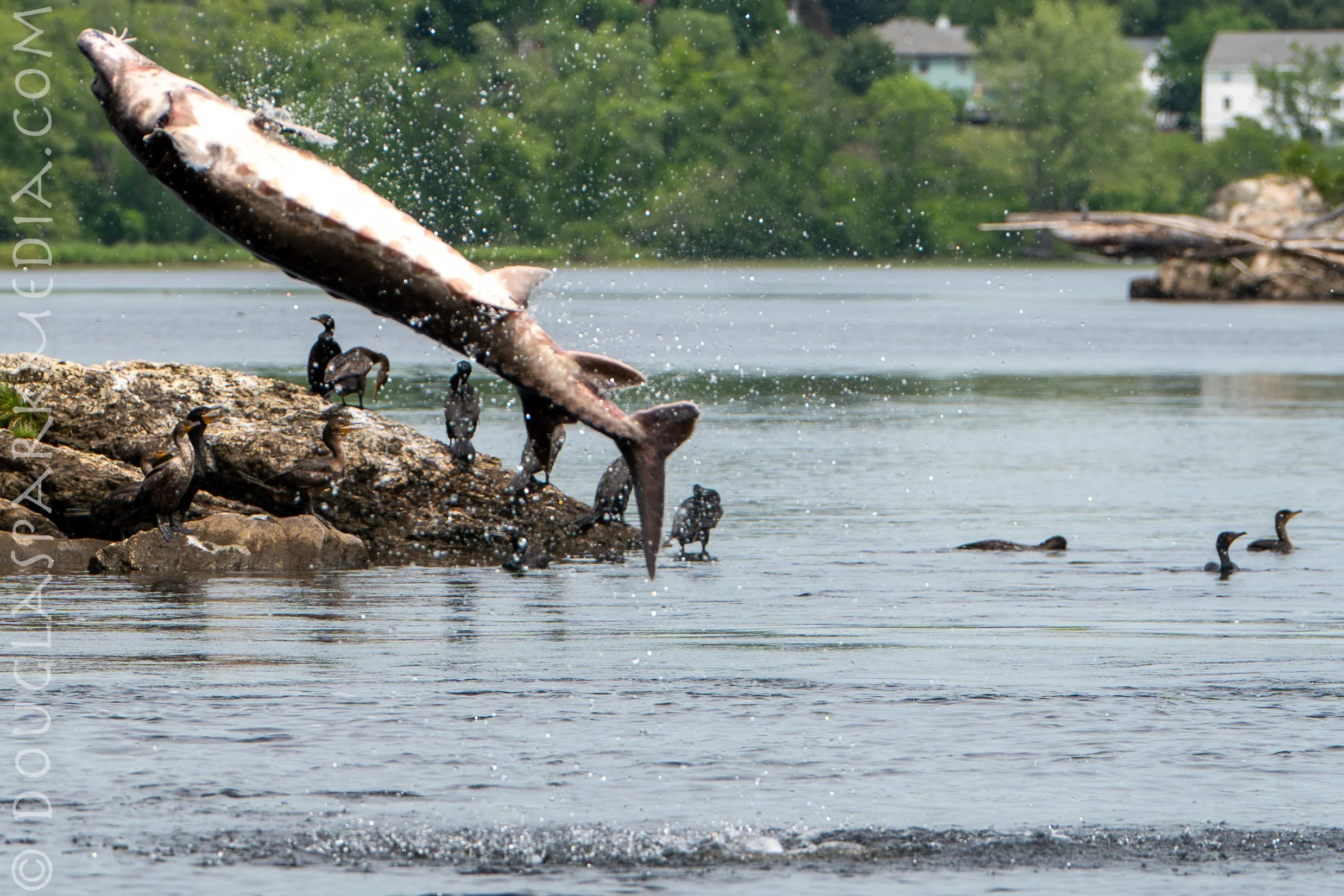
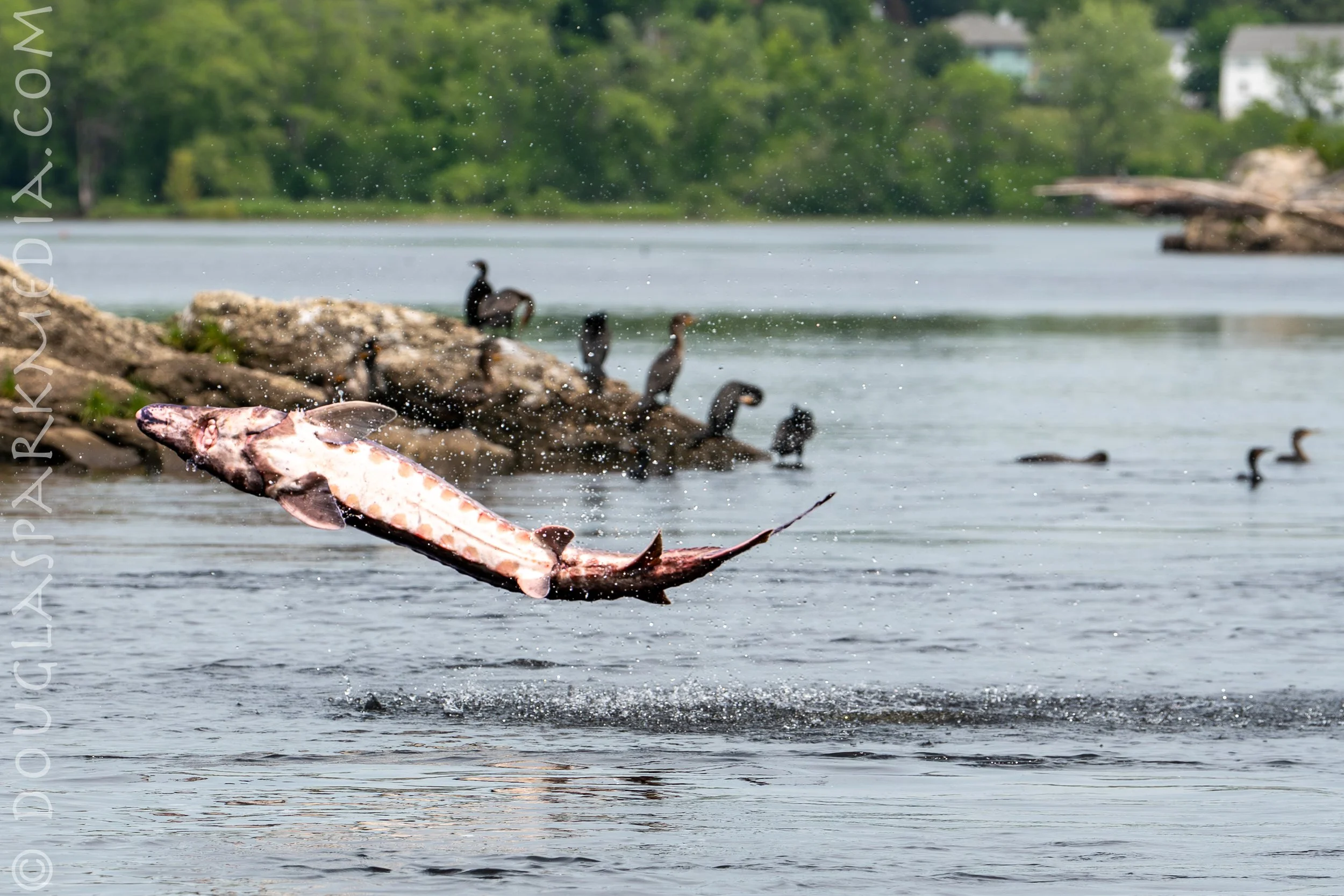
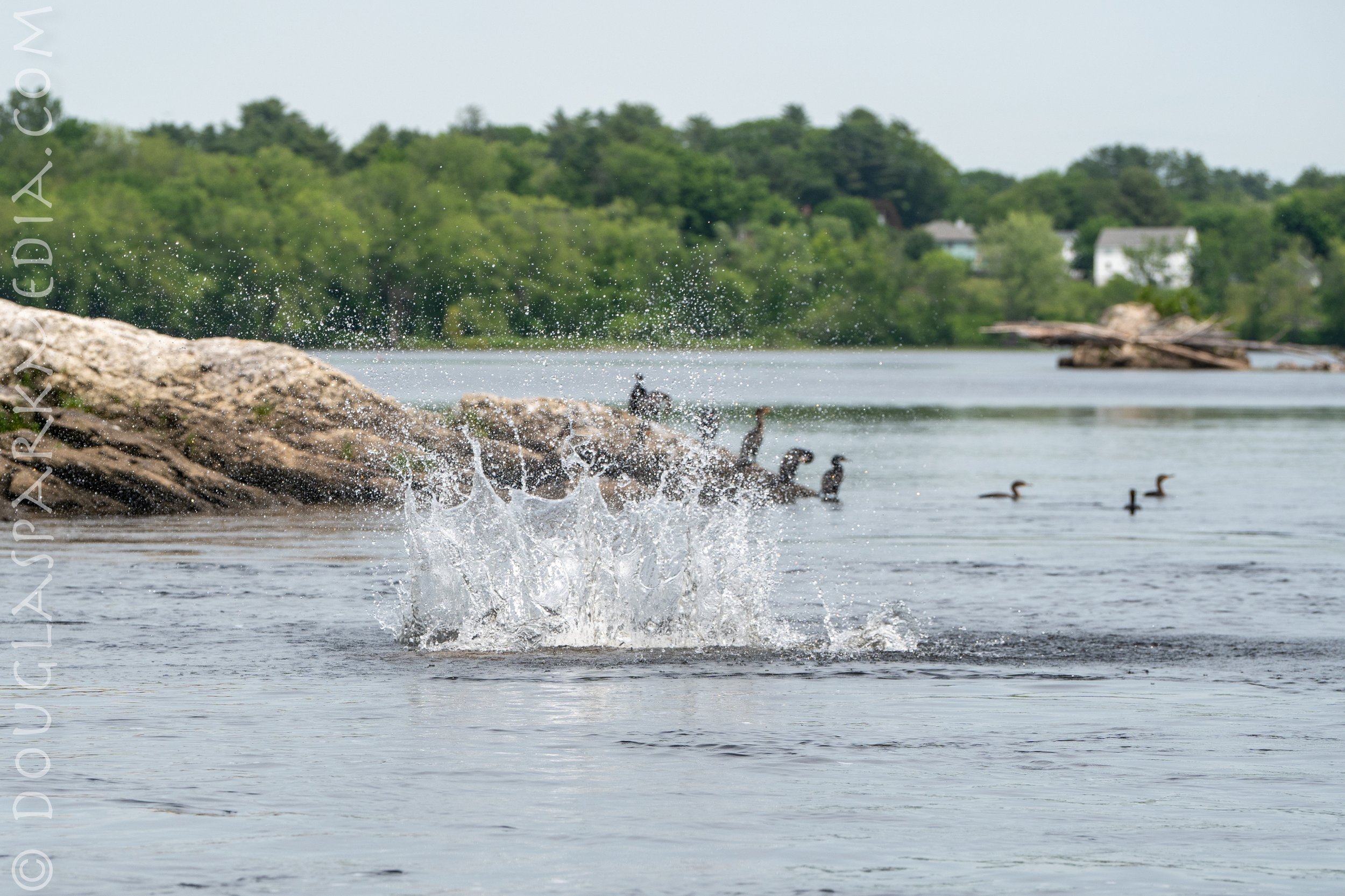
Not every sequence was perfect. I kept this though as the two out of focus frames add something to the third and fourth.
I gave up my favored single point focus point.
Focus was AF-C using the subject detect set to animals.
I compromised my field of view.
After a day of failure, I recognized that even though my favorite spot on the river offered me a viewing area of about 235° whipping my camera and body through that range every time I saw or heard something break the surface would lead to more bad shots. I was missing the better shots that were right in front of me in my frenzy to get every single jump.
I learned to enjoy spotting something down river and just letting it go. I savored the watery crashes over my left shoulder from up river beneath the bridge but had to let my imagination trace the acrobatic arc rather than my eye. I knew something else would be up and out of the water and much closer to me if I could just wait.
The river bends where I sat. After passing through a narrow spot defined by the peninsular Great Bowdoin Mill building, it is divided by ledges favored by Shags and Gulls. The river then briefly turns to the northeast it winds on toward Merrymeeting Bay. This bend offers a long view down the river rather than just across it. The prominence of Shag Ledge varies greatly according the the river flow but it divides the river into two discreet channels which focus the predatory activities of all the wildlife.
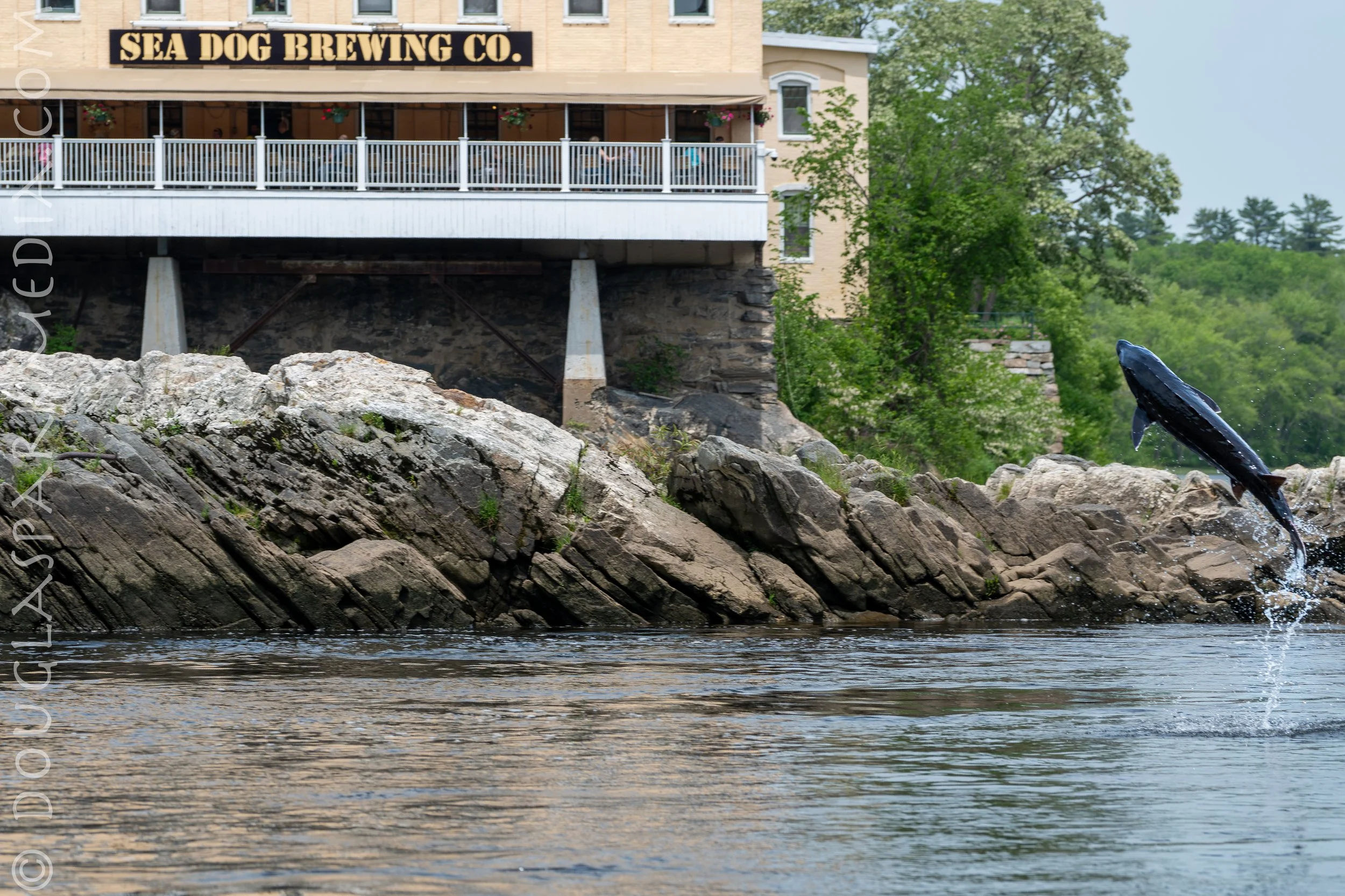
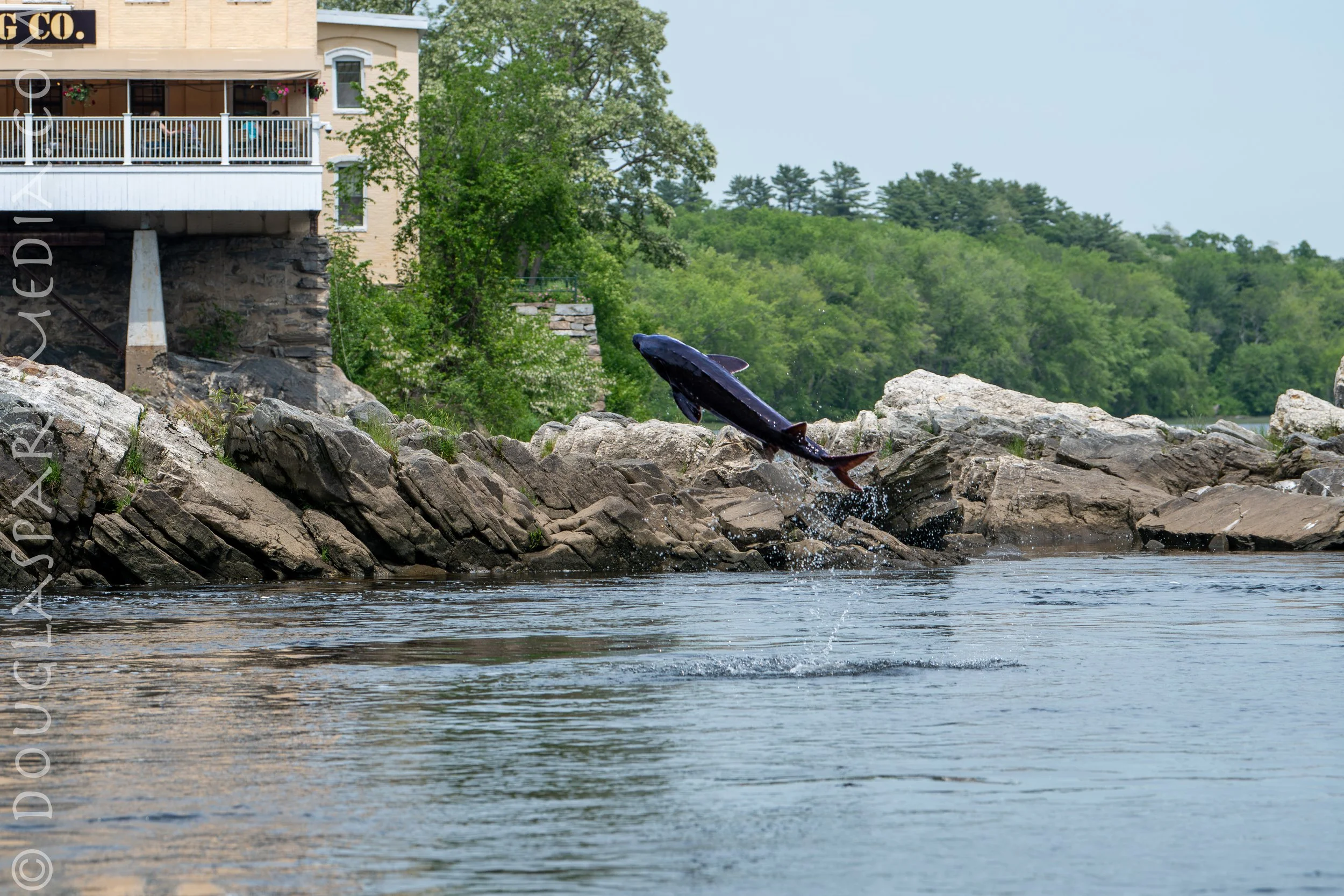
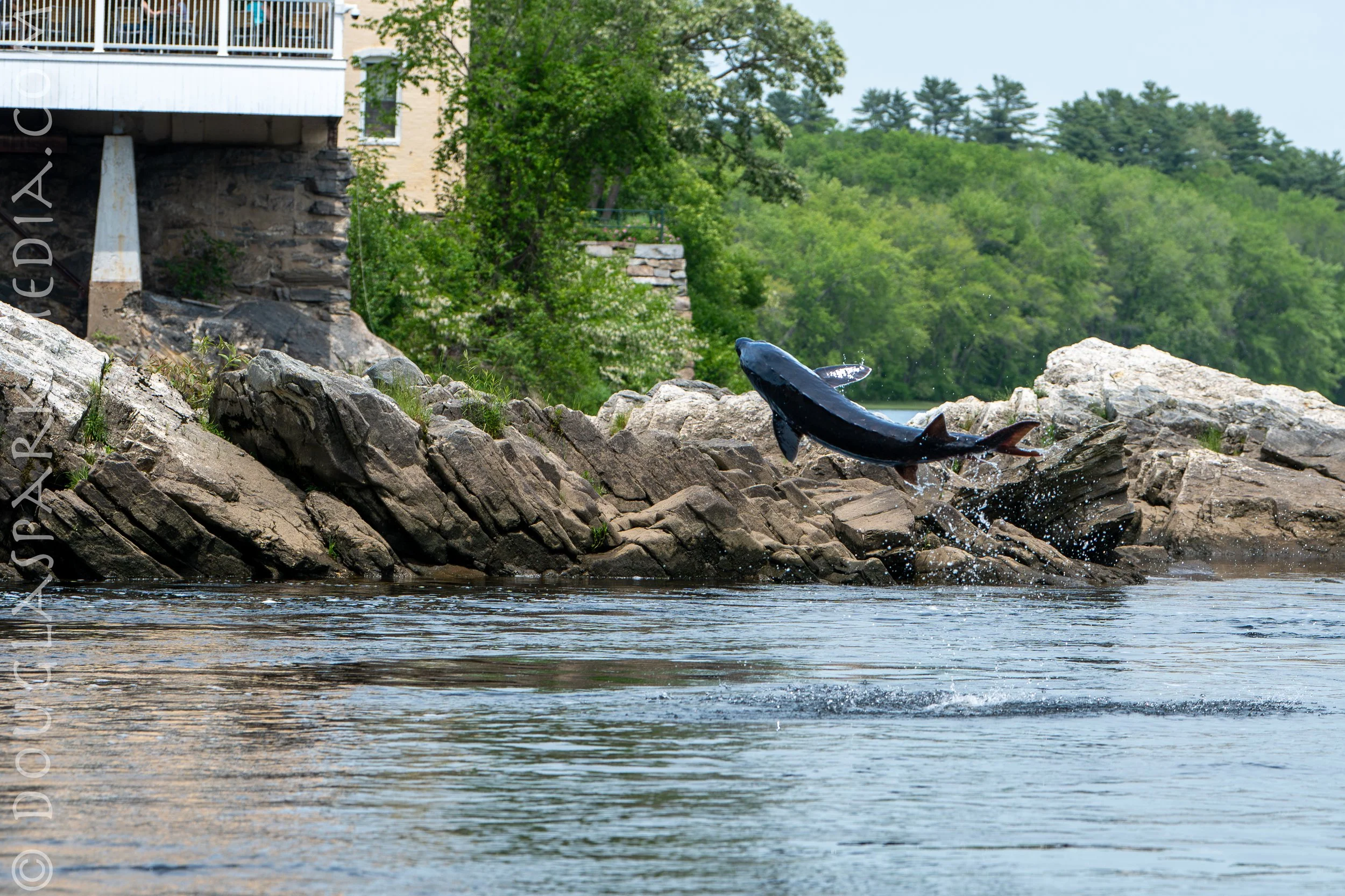
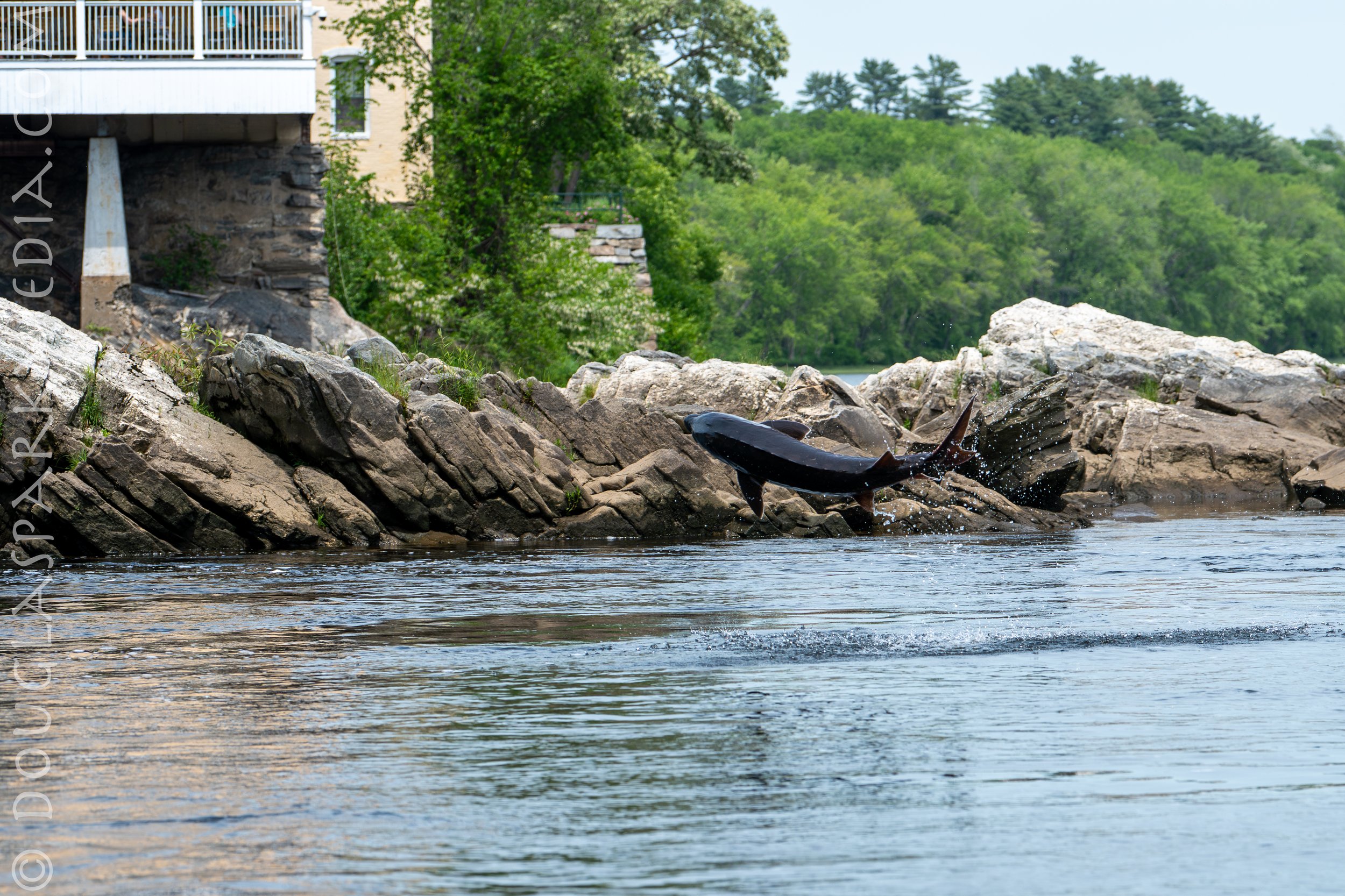
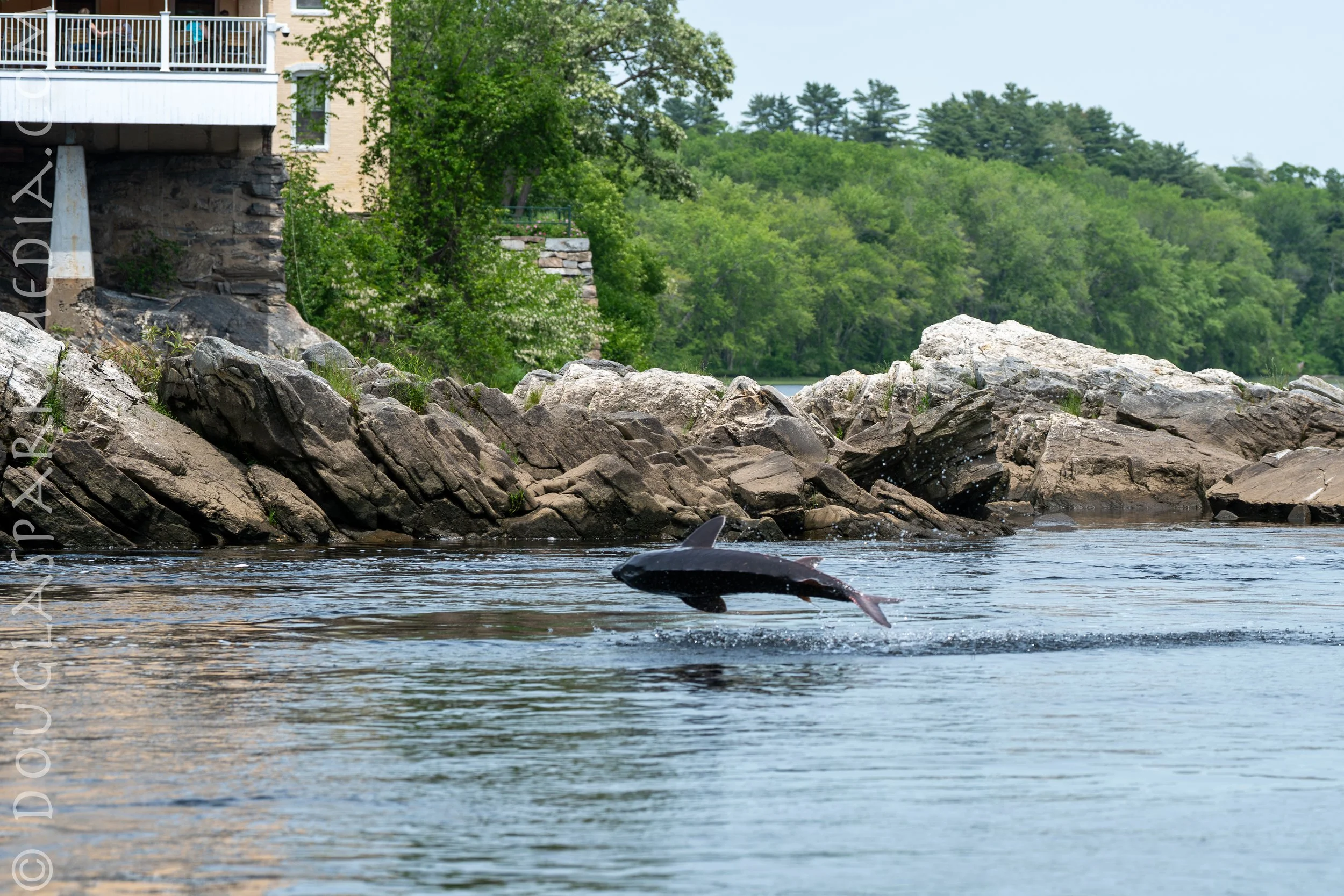
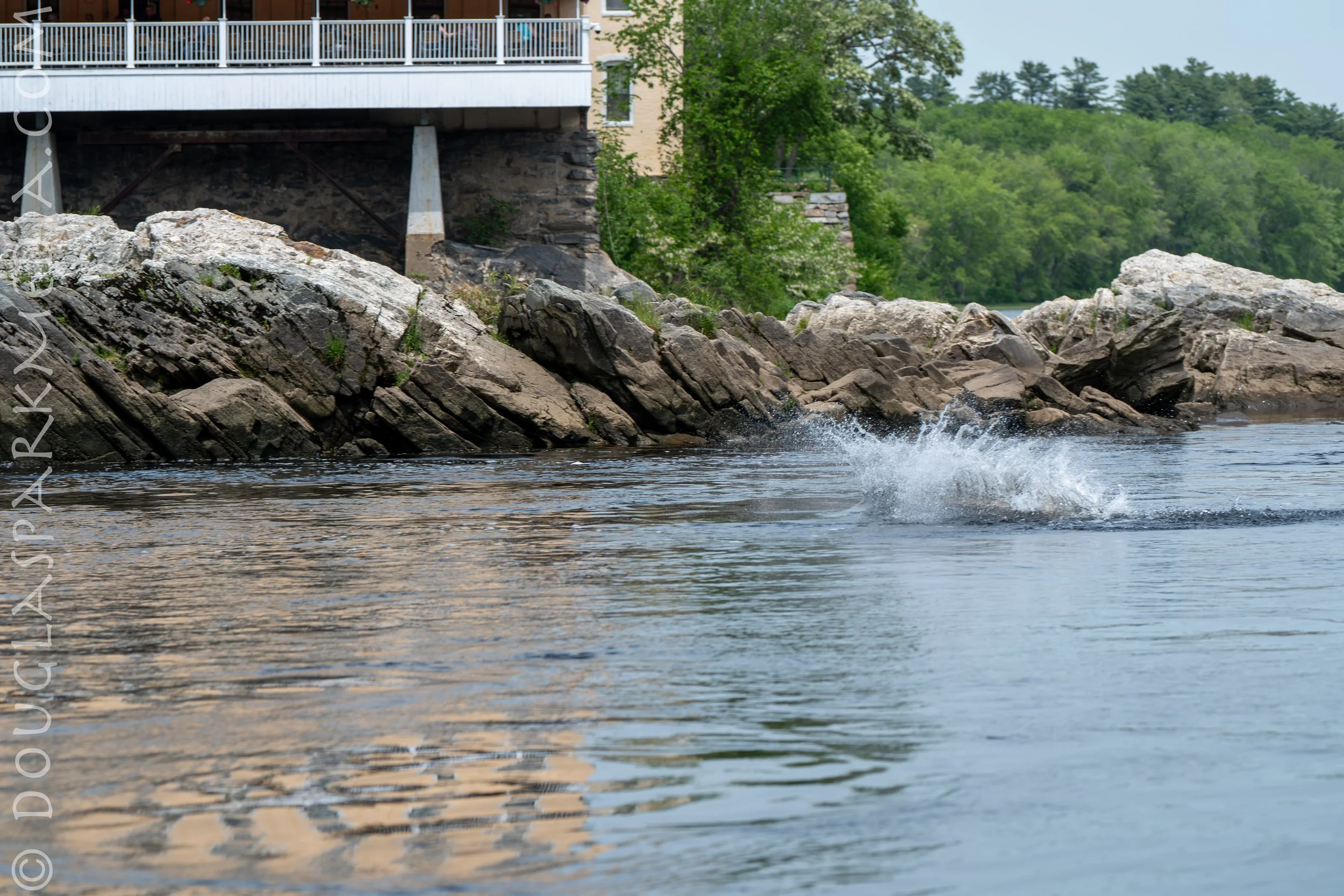
On the day I made these photos I did not attempt to shoot anything that wasn’t in that 60° wedge straight in front of me.
Exposure time 1/3200 sec.
I adapted my shutter speed. This fish doesn’t really travel that fast—it’s the abrupt emergence from the deep and gravity’s call back to the water that give the impression of speed—so on a bright day capturing them with a shutter speed of somewhere around 1/1250 should be perfectly reasonable. But the combination of the fish’s sudden appearance above the surface with the abrupt movement of my own torso to bring the fish into the field of view a shorter exposure seemed better. I settled a little short of the standard small-birds-in-flight benchmark of 1/4000 and opted for 1/3200. (f/5, ISO 360).
Percolation
Why do sturgeon jump? According to the Florida Fish and Wildlife Conservation Commission: Scientists have determined that the fish jump to communicate with other sturgeon and to refill their swim bladder so they can maintain neutral buoyancy.
The second piece about the swim bladder seems eminently provable, by anatomic studies and such.
But the first piece, communication, seems like it would have to be based on observation and deduction. Observing what happens beneath the waters where the fish spends most of its time is a challenge.
But there is a pattern to their behavior. You can go fifteen minutes without seeing a single jump and then see half a dozen in sixty seconds. It’s like there is a giant cosmic toddler with Fisher-Price corn popper—that two wheeled vintage push toy that would shoot little plastic balls around the inside of a clear globe—but only when you move it across that shag carpet. The toddler rests and the sturgeon stay submerged using their mustache-like barbels and their toothless protrusile lips to hoover the river’s bed. Moved by some urge the toddler lurches forward cackling for a few steps and the sturgeon spring into view, roll languidly and slap back down concussive finality like the cymbals of an orchestra.
If you see a sturgeon jump keep your eyes on the river because another will follow in short order—as if they’re talking with one another.
I had been documenting the river’s edge in Brunswick where the Frank J. Wood Bridge once stood in earnest since around 2021. As the legal challenges to its removal and replacement drifted from idealistic to quixotic, revealing the underside of the bridge appealed to me as a way of grounding my preservationist instincts with a dose of pragmatism.
Like most people of a certain age who grew up in the area I can recite chapter and verse of the river’s polluted past and what it was like to cross the Green Bridge as a child. Likewise the Swinging Bridge, a pedestrian bridge up stream has captivated the community for more than a century.
In 2023, as visible signs of construction began to appear, I began making regular trips to lurk by the river’s edge to document the progress.
A feature of the area, lodged between the two bridges, is the Brunswick Hydroelectric dam and its deficient fish ladder. It’s difficult to spend time at the river, especially in the spring time, without absorbing just how helpless the river’s fish are at the head of tide when they are confronted with this concrete wall. The frenzied gorging of the gulls, shags, herons and osprey animates the familiar phrase “shooting fish in a barrel.”
At the same time I had been reading Rachel Carson’s stirring first published work, Undersea, from the 1937 Atlantic Monthly. Caron’s lyrical 2500 words on the voyage of the catadromous eels from our rivers to the Sargasso Sea and back following their instinct to spawn in the mid-Atlantic tied in so nicely with Franklin Burroughs work in Confluence: Merrymeeting Bay. Burroughs chapter on the sturgeon traced the opposite journey as the sturgeon along with other anadromous fish like the salmon journeyed in the other direction. Both are stopped in their tracks by the dam.
I gassed on about this sometime in 2024-25 and made my first failed attempt to photograph the sturgeon in 2024. I ended up borrowing, with permission, the work of a local naturalist for the essay.
Now, when the fish ran in the Androscoggin in 2026, I accidentally succeeded. I will see you on the river’s edge in the spring of 2027.
Some Readings and Sources
Confluence: Merrymeeting Bay, Franklin Burroughs, 2006 Tilbury House Publishers, Gardiner Maine.
Undersea, Rachel Carson, The Atlantic Monthly, September 1937
Down East Photo Contest
NOAA fisheries sturgeon page
Florida Fish and Wildlife Commission sturgeon page
Sturgeon Isinglass: From Bookmaking to Breweries. Fascinating information about our history of use of the sturgeon. And you thought it was just caviar.
Save the Andro. Information about the fishway and the relicensing of the Brunswick Hydroelectric dam.
Return Of The Giants: Sturgeon Are Making a Comeback In The Northeast, Loren Merrill, Northern Woodlands Magazine, Summer 2026 pp 46.